In case you've missed it.
Tina is blogging about the trial that sent her mother's husband, Daniel Leaf, to prison, again.
Be sure to check out her blog at Glimpses of Hope.
Going to trial is not easy. Knowing it affects your mother, makes it worse.
Justice was served but not without a lot of emotional consequences.
Read about her journey.
I hope it inspires you.
Showing posts with label Chuck Phelps. Show all posts
Showing posts with label Chuck Phelps. Show all posts
Thursday, January 8, 2015


Sunday, April 14, 2013
ABUSE: People just don’t “Get It”
People who have never been abused will never understand. If you’ve never been in a highly authoritative religious environment, you’ll never understand what it means to be spiritually abused. If you’ve never lived in a home where your father and/or mother physically abused you, you’ll never understand what it is to be a child in that environment and how that abuse will affect you the rest of your life. If you’ve never been raped or physically violated, you’ll never understand the trauma, emotions, conflicts, reactions, etc. that happen before, during and after an assault.
I’m one of those people. The closest one that I understand is spiritual abuse because I have been in some spiritually abusive churches and organizations but my experiences are extremely mild compared to some I’ve seen and others I’ve heard about. My parents didn’t beat me. Although I’m sure some of my punishments were excessive and I did get spanked, I would never consider myself abused. I do know numerous people who have been raped and even though I live with someone who has, I’ll never truly understand what she’s gone through and what she’ll deal with the rest of her life because I’ve never experienced it.
Here are some other things that I don’t “get.”
#1 Parents…
a.
Who abuse
b.
Who marry a known abuser
c.
Who don’t protect their children from an abuser
d.
Who chose an abusive spouse over their own abused child
e.
Who reject a child that’s been abused
I just don’t understand anybody who abuses another
person but even more, a parent who abuses their own children. How can a parent
kick, punch, hit, slap, push or use any form of physical violence against their
children? I do understand spanking but even then there are other forms of
effective discipline that don’t require you to hit a child.
I understand even less raping your own children.
How can a parent do this? It’s so disgusting and revolting that I just don’t
understand how any person can do that to another person, let alone a child.
How can a person turn their back on their children?
Why would a parent stand up for the abuser and turn their back on their child
who has been abused? I’ve heard too many stories of parent(s) turning
against their child because the child finally had the courage to speak up. The
mom doesn’t want to send her husband to jail but would prefer he keep abusing.
The parents blame their daughter or son for being molested by a relative,
friend, sitter, or church member.
I’m just disgusted and I don’t understand the
mentality of parents not supporting their abused children.
a.
Abuse by leaders and church members
b.
Cover up abuse
1.
“You don’t want to break up a family, do you?”
2.
“We’ll deal with it internally.”
3.
“If this gets out, it will hurt our ministry.”
4.
“You shouldn’t take another Christian to court.”
5. "Let's not dig
up the past. He's changed. He's not the person he used to be."
c.
Give Platitudes
1.
“forgive and forget”
2.
“just get over it”
3.
“let God deal with it”
4.
“you need to give it to God”
5.
“don’t become bitter”
d.
Disregarding
1.
"Our church is not like that."
2.
"We’re autonomous." or "We're not responsible for what that
church does."
3. "Those
bloggers, advocates, and victims are just bitter."
4. "Your
PTSD, nightmares, and other problems are not real. It's all in your head.
You're just dwelling in the past."
5. "You're just
being vindictive."
It really bothers me that some churches don’t “get
it.” They just don’t understand and what’s worse, they don’t seem to want to
understand. They’re more concerned about image than justice. They’d rather
enforce rules than practice grace. They’d rather be on the defense for
religious leaders and organizations than on the offensive for the abused.
I don't understand why church leaders and
organizations will condemn another church over music, clothing, and other
standards but they won't address that same church or organization when there is
a known issue that the pastor or leader who is abusing, has abused, or has
covered up an abuse.
We need to understand that helping a victim is what God wants us to do. We need to worry about our heart being right with God, not protecting an "image." Let's have character and let God worry about His image. Let us worry about doing the right thing. When we do that, we show the world how God loves.
God’s love is what I want to understand. His love is what I have experienced and that is what I want to demonstrate to those who’ve been abused.
Friday, March 1, 2013
Why Would a Pastor Cover Up Abuse?
Ever since Tina's story first became public in May of 2010, I've had a dozen or more conversations with people that just can't wrap their minds around how Chuck Phelps could have made the decisions he did. Why did he call the police but not follow up by submitting a written report? Why did he decide to allow Ernie Willis to remain in the church, even serving as an usher and attending youth activities with his children while Tina was sent away? How could a pastor that professed to love people seem to have more concern for Ernie's family than a 15 year old girl that was raped? How could he have participated in a 15 year old girl being brought before a congregation full of people to apologize for her part in a "compromising position" (pregnant from a 38 or 39 year old man who admitted to the pastor he was the aggressor)?
For those that did not grow up in independent fundamentalist churches, the situation is beyond puzzling. It seems bizarre -- obscene even. How could the adults in the congregation not interrupt or intervene? I came across a video online that may help some asking those kind of "why" questions understand a little bit better. The video is of Bob Wood teaching a counseling class at Bob Jones University back in 1994. Bob Jones University is where Chuck Phelps got two degrees. Did he sit in this class I wonder? How many other graduates of Bob Jones University went on to teach similar classes to this at other schools in the BJU orbit? Did any of them teach at Hyles Anderson College? How many churches (along with their attached schools) and mission agencies (and attached schools) have been infected by this insidious, disgusting teaching?
Darrell over at Stuff Fundies Like posted the video with Bob Wood's teaching with his own comments.
Scriptural Principles for Counseling the... by EricITGuyatTHGC
I just can't help but wonder how many students sat under teaching like this at Bob Jones University and later applied the principles in the lives of children still suffering the damaging effects today. It is completely heartbreaking.
For those that did not grow up in independent fundamentalist churches, the situation is beyond puzzling. It seems bizarre -- obscene even. How could the adults in the congregation not interrupt or intervene? I came across a video online that may help some asking those kind of "why" questions understand a little bit better. The video is of Bob Wood teaching a counseling class at Bob Jones University back in 1994. Bob Jones University is where Chuck Phelps got two degrees. Did he sit in this class I wonder? How many other graduates of Bob Jones University went on to teach similar classes to this at other schools in the BJU orbit? Did any of them teach at Hyles Anderson College? How many churches (along with their attached schools) and mission agencies (and attached schools) have been infected by this insidious, disgusting teaching?
Darrell over at Stuff Fundies Like posted the video with Bob Wood's teaching with his own comments.
Scriptural Principles for Counseling the... by EricITGuyatTHGC
I just can't help but wonder how many students sat under teaching like this at Bob Jones University and later applied the principles in the lives of children still suffering the damaging effects today. It is completely heartbreaking.
Monday, January 14, 2013
Please Pray for Tina
I'd appreciate it if you would take a few moments and pray for Tina. Most of us can only imagine the stress that a survivor of abuse deals with throughout their entire lives but then imagine that your life is lived in the media for the world to see and that stress just multiplies. Sometimes the story dies down and you can go on to live a semi-normal life but for Tina her life's struggles just keep popping up into the public through the newspapers, courtroom proceedings, Facebook, survivor groups and blogs, religious organizations, and the list goes on. It's very overwhelming.
You may have heard that Ernie is appealing his conviction.
Cached text version of Concord Monitor article
Tina needs your prayers. Even though some say it's highly unlikely that the conviction will be overturned, just the chance that it might can really cause some sleepless nights.
Here are some specific things you can pray for.
Please pray and I'm sure she could use some words of encouragement.
Thank you for all your prayers. Thank you for your love and concern for our family. It is greatly appreciated.
You may have heard that Ernie is appealing his conviction.
Cached text version of Concord Monitor article
In the article it says, "Willis’s lawyers, though, believe those conversations should have been off limits, protected by a religious privilege that allows a minister to not disclose confessions made to him in his 'professional character as a spiritual advisor.' On Wednesday, they’ll argue the issue before the state Supreme Court, asking that the justices overturn Willis’s convictions."
Tina needs your prayers. Even though some say it's highly unlikely that the conviction will be overturned, just the chance that it might can really cause some sleepless nights.
Here are some specific things you can pray for.
- God's peace in Tina's heart.
- God's wisdom and strength in Tina's life to go through the challenges that she must face.
- God's healing of Tina's body, soul, and spirit.
- Wisdom for the State Supreme Court that justice will continue to be served.
- Whatever else God lays on your heart.
Please pray and I'm sure she could use some words of encouragement.
Thank you for all your prayers. Thank you for your love and concern for our family. It is greatly appreciated.
Saturday, August 25, 2012
Daniel Leaf Indicted for His Abuse of Tina Anderson
Daniel Leaf has been indicted for his abuse of his stepdaughter, Tina Anderson, when she was a young child.
"Man named in rape trial now indicted: Stepfather faces sex assault counts"
by Maddie Hanna on August 23, 2012
A few quotes:
Tina's biological mother, Chris Leaf allowed Daniel Leaf back in her home even though he had been imprisoned in Arizona and NH for abusing the children (convicted of assault with evidence of extensive bruising). In addition, Daniel Leaf was a convicted child sex offender. She continues to live with him today in NH. Clearly, she chose her pervert, pedophile, child abusing husband over the well-being of her children.
More from the article...
"Man named in rape trial now indicted: Stepfather faces sex assault counts"
by Maddie Hanna on August 23, 2012
A few quotes:
"When she testified last year to being raped and impregnated as a teenager in 1997 by a married man who attended her Concord church, Tina Anderson told jurors she also had been sexually assaulted by her stepfather years earlier.
Anderson said at trial that her mother and her pastor at Trinity Baptist told her to forgive her stepfather, Daniel Leaf, for the abuse, and he never faced charges in connection with her allegations.
That changed last week, when a Merrimack County grand jury handed down two aggravated felonious sexual assault indictments charging Leaf with assaulting Anderson between 1990 and 1992, starting when she was 10 years old."The topic of "Forgive & Forget" was brought up at the trial of the man who was convicted of raping Tina. You can read more about that here.
Tina's biological mother, Chris Leaf allowed Daniel Leaf back in her home even though he had been imprisoned in Arizona and NH for abusing the children (convicted of assault with evidence of extensive bruising). In addition, Daniel Leaf was a convicted child sex offender. She continues to live with him today in NH. Clearly, she chose her pervert, pedophile, child abusing husband over the well-being of her children.
More from the article...
Hopefully, Daniel Leaf will finally be held accountable for the abuse of Tina. She deserves justice, as do all children abused by anyone. Children should be safe in their homes, churches and schools. In my opinion, pedophiles should never be released from prison. I believe the recidivism rate demonstrates that they just cannot be trusted to be around children ever again. Keeping them locked up seems to be the only way to protect children from them."He was also convicted of second-degree assault in 1992, according to the registry. Christine Leaf, his wife and Anderson's mother, testified in court last year that her husband had been found guilty of the assault for spanking her son. She said he spent seven years in prison for the sexual assault conviction, which she said related to a victim who wasn't one of her children.Yesterday afternoon, Christine Leaf answered the door at the couple's house in Tilton and said she did not think her husband, who was inside, would wish to comment."Really, I don't think we have anything to say," Christine Leaf said, asked whether her husband maintains his innocence."
Tuesday, August 7, 2012
Critique of Chuck Phelps' Forgiveness Lesson (Pg6)

“The Tough and Tender Side of Forgiveness”
At #5, Vertical Forgiveness says, “Rather than seeking
vengeance, the believer releases the penalty to God.” These verses deal with
vengeance not penalty or consequences. We don’t take matters into our own hands
but part of putting it into God’s hands might include putting it into the hands
of law enforcement. I’m so afraid that this “releasing penalty to God” will
cause some Christians to ignore sin thinking that God will take care of it when
God’s already put in place a system to take care of sins.
Chuck Phelps goes into the definitions of love. I’m not sure
why this Greek lesson is necessary to understanding “tough love.”
“Love must be tough”
#1 – Why do feelings have to be overcome before confronting
an offense or sin?
#2 – Why can’t I offer forgiveness before it’s asked for?
a.
He says it’s because it “robs the offender of the lessons of
guilt.” No, the lack of relationship due to unresolved sin is what might bring
conviction but there is nothing wrong with letting the offender know that
forgiveness will be granted or is being offered if offender asks.
b.
Is waiting for someone to ask for our forgiveness the only
model that we’ve been given? No, on the Cross, God gave us the example of
forgiveness offered before it was asked for or even before we realized we
needed it.
#3 – We may need to confront
a.
Matthew 18:5-6 says nothing about confronting sinner, he
probably means vs. 15-16.
b.
Matthew 5: 23-24 says if you know someone has something
against you, get it resolved.
c.
Luke 17:3 says that if a brother sins, confront him. The sin
does not have to be against you to confront him.
#4 – Cover offenses
a.
I Peter 4:8 does not say we hide sin. It has the idea of not
being offended by everything a person does. We love in Christ and are not
selfish and think of others before ourselves.
b.
“don’t confront unless good for the offender” – confrontation
of sin is always good for the offender, even if the penalty of sin does not
seem like it, the purpose is restoration of relationship with God, that makes
confrontation good.
Forgiveness is a tough subject and sometimes misunderstood
or misapplied. We sometimes forget to make a difference between a crime
(breaking the law and a sin against a person) being committed against someone
and an offense (may or may not be a sin) committed against someone whether
intentional or not. There needs to be a distinction between these two things
and how forgiveness should work in these two different situations.
I’m going to put together my own lesson and how I’d address
forgiveness if I was leading this class.
Tuesday, July 31, 2012
Critique of Chuck Phelps' Forgiveness Lesson (Pg5)

Offended Person
#1 – vertical forgiveness – why? Did the offended person
sin? I guess one way is to ask God to forgive the person, just like Jesus did
on the Cross for us but the offender would still have to accept that
forgiveness and so the sin must still be dealt with.
#2 – did the offender sin? Chuck Phelps calls it a “true
offense.”
Not all
offenses come from sin. Sometimes people feel they’ve been “sinned” against but
they have not but it’s still something that needs to be resolved. Mistakes,
misunderstanding, differences of opinion, or any other number of things can
cause problems between people. If we weren’t prideful, selfish, self-centered,
and sinful people, we’d be more understanding and have less problems but that’s
not going to happen.
If it is a
sin, we should also ask, “was it a crime?” “Did he break the law?” And then we
should deal with it accordingly.
#3 – “Confront those who offend you.” The beginning of Luke
17:3 states that “if a brother sins, confront him…” We seem to focus on the
person who was offended doing the confrontation but that does not need to be
the case. If I know someone has sinned against another person, I also have that
responsibility to confront the sinner.
a.
– obedience not revenge – as long as we realize that
consequences are not revengeful
b.
– for the good of the offender –what?
c.
– designed to edify – what?
I think I know
what he’s saying but confronting sin is for the good of the body of Christ. Dealing
with sin does not always seem good to the offender but if sin is dealt with, it’s
good in the long run, even with consequences.
#4 – forgive ….”unconditionally”… I may need to forgive unconditionally but that does not mean that
the consequences of the offense are removed and I’m afraid that the removal of
consequences is usually how this is interpreted.
#5 – Proverbs 15:1 has nothing to do with this statement
#6 – II Thess. 3:14-15 does not apply to this statement
either.
#7 – What does forgiveness have to do with looking for real
change from the offender?
The Offender
#1 – “own your offense” – good
#2 – “demonstrate your repentance” – “..might include…before
a civil magistrate.”
– this is the only time law
enforcement is mentioned and in such a strange way. If he broke the law, this
should not be optional and the offended has this option as well.
#3 – don’t expect to be “best friends” immediately
Sunday, July 22, 2012
Critique of Chuck Phelps' Forgiveness Lesson (Pg4)

Again, the first half of the lesson is going over what he’s
gone through in the first three lessons. In #5, under Vertical Forgiveness, he
states, “Instead of seeking vengeance, I am to UNCONDITIONALLY release the
offense to God.” I would say that this is fine and good unless a crime has been
committed, such as: theft, murder, rape, molestation, vandalism, etc. We can
still release the offense to God but this still does not release the person
from the justice of the law. Justice is NOT vengeance. It is a form of
releasing the offense to God through the means of law enforcement whom God has
put in place to deal with those things.
In #6, Chuck Phelps clarifies the “condition” of forgiveness
by saying that the offender can’t receive forgiveness unless he asks for it
from the person whom he has offended. I would say that this is correct and I
would also say that this is when relationships can start being repaired.
He then goes on to talk about “forgiving and forgetting.” He
does not spend much time with this and in this lesson does not appear to be
equating the two but that you choose to “forget” even if it comes to your
memory.
I dealt with the idea that forgiveness does NOT equal
forgetting and you can read my post called FORGIVE
= FORGET?
Thursday, July 19, 2012
Critique of Chuck Phelps' Forgiveness Lesson - (Page 3c)
The
“Why” of Forgiveness was addressed in handout 1 but it’s expanded even more
here. In Matthew 6, Jesus never says that fellowship will be broken. This may
happen but it’s because the sinner refuses to fellowship and holds on to an
unforgiving spirit. You can’t have a good relationship and it’s hard to
fellowship if you don’t forgive but God doesn’t cut off fellowship with us. He
keeps working in our hearts to bring about forgiveness. Psalm 66:18 is not
about powerful praying but about God not listening because we love our sin.
Although God does say that we need to forgive, John 14:15 says that we’ll keep
God’s commandments if we love Him. Although Chuck Phelps is correct in his
statement, he could have used a better verse. Eph 4:32 says to forgive others
because God has forgiven us.
Romans
12 talks about our relationship with one another and how a Christian should act
towards one another no matter how that person treats you. Our natural tendency
as a human is to treat others like they have treated us. In this passage, God
is telling us to live differently and that God will take care of it. When God
says, “Vengeance is mine, I will repay,” you know it’s in God’s hands. This
does not mean to overlook sin. Sin must be dealt with. If someone has committed
a crime, God has placed people in authority who can deal with criminals.
Seeking justice for a crime committed is NOT vengeance. Both forgiveness and
justice can be accomplished together, they are not mutually exclusive.
And
the final and probably the worst reason a person should “learn to forgive” is
to “avoid the chastisement of God.” He uses Hebrews 12:6 that states that God
disciplines his “sons.” What I think Chuck Phelps is saying is that if you
don’t forgive, you are disobeying God, and if you disobey God, He will chastise
you. So, if none of the other reasons for learning to forgive work, be afraid
that you’ll get punished if you don’t forgive. I don’t believe that you need to
be afraid of God’s discipline. It may not be comfortable or nice but it’s
designed to teach and mold us into His image, unlike some of our chastisement
of our children, which is usually to make them pay for doing something wrong
and to teach them not to disobey us.
Critique of Chuck Phelps' Forgiveness Lesson - (Page 3b)
Here’s my biggest issues with this so far. This lesson is
equating forgiveness with restoration of relationship and the two do not
necessary go hand in hand. Forgiveness is a step toward restoration of
relationship and that is the ultimate goal but there can be forgiveness without
restoration.
For example, Christ died for the sin of the world. He paid
the penalty for all sin and has offered forgiveness to the world but each
individual must accept that gift of forgiveness and salvation to have that
relationship restored. Jesus on the Cross said, “Father, forgive them for they
know not what they do.” He forgave them without a “contract” or a “meeting” or
any “fellowship” at that time.
Critique of Chuck Phelps' Forgiveness Lesson - (Page 3a)

He does a review of the first two lessons. Always a good
idea when teaching. Then Chuck Phelps is going to talk about the How and then
the Why of forgiveness just like he did in lesson one but he’s going to come at
it from a different angle.
He divides the How into Vertical Forgiveness (VF) and
Horizontal Forgiveness(HF). I’m not sure “how” is the best term. It’s more an
explanation about Vertical and Horizontal Forgiveness.
I wish he’d be more clear in his statements. Sometimes I
wonder which statements are addressing the offender or the offended. In VF he
states seven things. I can understand where he’s coming from on most of them
but there are a couple I’m not sure about.
-- “VF is
unconditional.” It’s only true because God already paid the price for our sin
and God promises forgiveness. This does not remove the natural consequences of
sin.
-- “VF does
not require that the offender show repentance.” – This one puzzles me but my
forgiveness is conditional on God’s actions on the Cross, not my behavior.
-- “VF is between the offended
party and God.” – Why would the offended person need forgiveness? I believe
this would apply to the offender.
-- “VF is a contract between God.”
I’m not sure what this “contract” is about. My forgiveness is based on God’s
work on the Cross and His promise that He’ll forgive me of my sins.
Wednesday, July 18, 2012
Critique of CP's forgiveness (pg2)
FOUNDATIONS OF FORGIVENESS - Handout 2
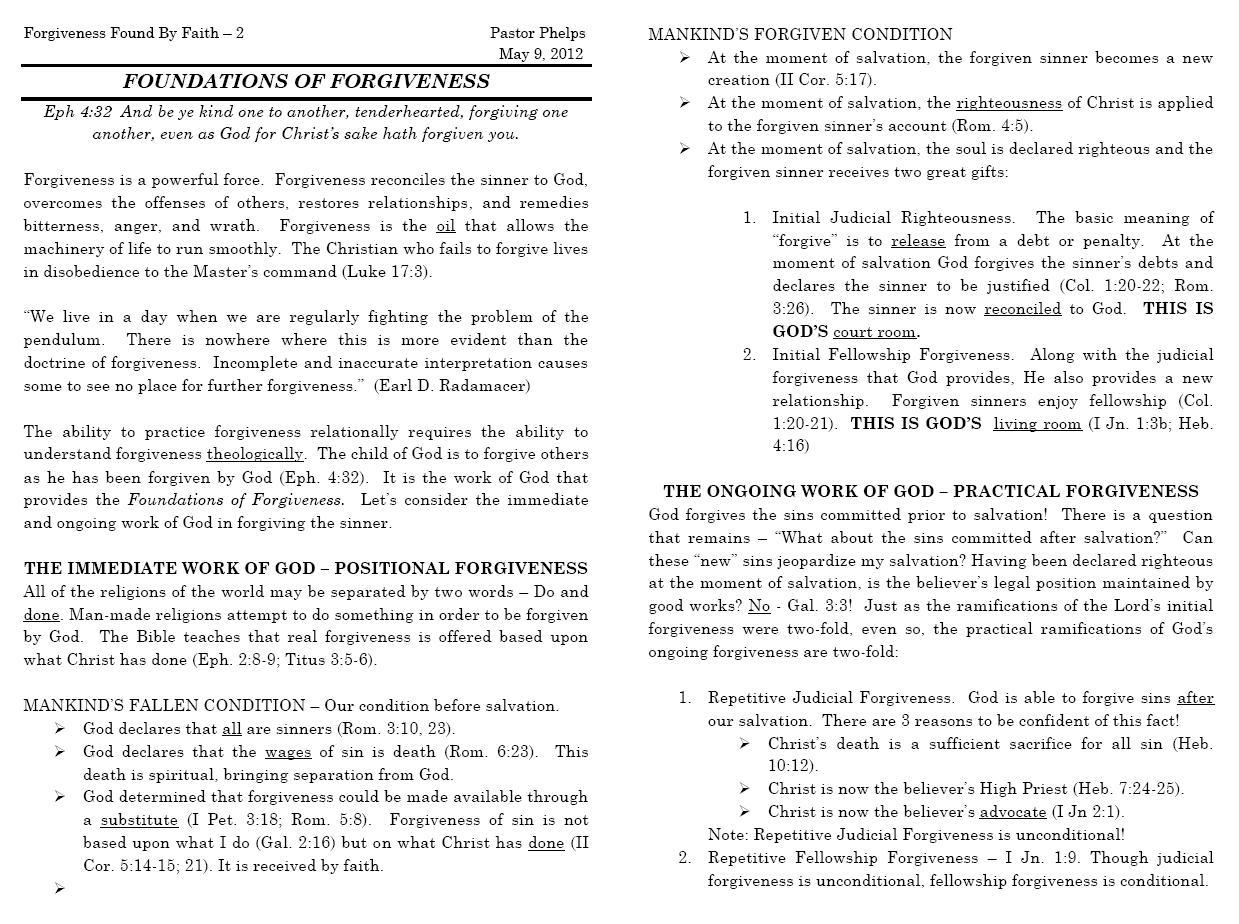
Chuck Phelps is correct about mankind’s forgiven condition
but then he gets to the definition of “forgive.” In column two he states, “The
basic meaning of “forgive” is to release from a debt or penalty.” It sounds
good until you realize that our debt and penalty is not released, it’s already
been paid. Christ’s righteousness is applied to us. Yes, we don’t have to pay
the penalty ourselves and in that sense we are “forgiven.”
Why I think this is important is that just because
forgiveness has been sought for and has been granted, it does not absolve the
fact that there are consequences to doing wrong. Chuck Phelps is not dealing
with it here but later we’re going to see God’s command to forgive, just like
Christ forgave us, and we should, but that does not stop the consequences of
sin and I believe this is a big area where Christians, especially IFB, have
issues.
I think the courtroom and living room analogies are good. It
gives you a visual of your relationship with God.
Monday, July 16, 2012
Critique of Chuck Phelps' lessons on forgiveness (pg1)
I’m going to do a critique of Chuck Phelps’ forgiveness
lessons that he did at CHBC around May 2012. It will be done in parts because
there are so many things I want to address. I hope that you’ll bear with me. If
you’d like to know my credentials and my background, check out my tab.
At first glance, Chuck Phelps’ forgiveness handouts look
fine, professional, and credible. I would expect to see these in most other IFB
churches. The concepts or different aspects of forgiveness that he is teaching
are not original with him but I’m assuming that he put these together for his
use in his church. On closer examination, I’m having some real issues with what
he is teaching and others like him are preaching as well.
I’m beginning to realize that the reason people have a hard
time understanding forgiveness is because of the way it is taught or explained.
We get confused between God’s forgiveness and our own forgiveness and how that
should look. The other confusion comes from the mixture of topics and/or
incomplete explanations of different aspects of forgiveness. The way Scripture
is used can also cause problems with understanding because it is not always
used properly. I’m seeing all these issues and more as I study Chuck Phelps’
handouts closely.
Handout 1 – Jephthah – The Power of Finding Forgiveness

First of all, I find this a strange example to use for
forgiveness. Nowhere in this story is forgiveness addressed. Yes, he was humiliated and rejected but nowhere in the story do I see forgiveness
being asked for or received. There was a deal made and questions asked. Later
he asks his daughter to forgive him of the vow he made but that’s not addressed
in this lesson.
How about the following examples that could have been used?
Adam and
Eve – God’s forgiveness of their sin in the Garden of Eden.
Joseph –
forgiving his brothers who sold him into slavery. Definitely an example of
humiliation and rejection.
Bathsheba –
abused by David’s power and authority. Whether it was willing or not, David
took advantage of Bathsheba. That is abuse. Not only did he violate her, David
also murdered her husband. We don’t see Bathsheba’s side of this story but at
some point David probably asked for Bathsheba’s forgiveness.
David –
God’s forgiveness of David’s adultery, his counting the people, and other
examples.
Hosea –
this prophet was instructed to marry a harlot who kept going back to her
whorish ways and he kept bringing her back.
Jesus –
many, many examples but the biggest example is Him forgiving us of our sins on
the Cross.
Stephen –
stoned
Paul and
Silas – jailed
I’m sure there are many, many other examples. These were the
ones that came to me off the top of my head.
Forgiveness is difficult at times and the reasons that Chuck
Phelps gives would be accurate.
Chuck Phelps then goes into How Forgiveness is Granted but
does not really answer the question. He gives some aspects that might help in
the forgiveness process and he uses Scripture out of context and misapplies the
Scripture. James 5:16 has nothing to do with “the facts are clear.” It has to
do with healing and making things right with one another and your prayers will
be effective and powerful and healing will occur because you’ve made this right
between God and each other.
James 5 would have been a good passage to use on Why
Forgiveness is Necessary but it’s more from the aspect of confessing your sins
and not necessarily forgiveness being granted, but that’s implied. In this
section he says that in finding forgiveness, you find power. I realize what
he’s trying to say but it’s actually the prayers that are effective and
powerful. It’s more accurate to say that sin in your life is causing the loss
of power. The emphasis seems misplaced in that it’s not the one granting
forgiveness that gains spiritual power but the one asking for forgiveness of
sin.
I Peter 3:7 tells you to honor your wife so that your
prayers are not hindered. Although a husband may need to ask forgiveness from
his wife from time to time, forgiveness is not what this passage is talking about.
Mark 11:25 says for you to forgive someone if you have
something against them. This does not say who was in the wrong but ask
forgiveness for what you have against them and in turn God will forgive you.
Acts 24:16 Paul made sure that he had a clear conscience
with God and man.
Here is what occurred to me as I was going through this
lesson. Our focus is on the wrong person. We talk about forgiveness and we
focus on the person who was offended and sinned against and how they need to
forgive. That is true but I believe our biggest focus should be on the one who
did the offending and their confession of sin. It should be focused on the act
of seeking forgiveness than giving forgiveness.
Tuesday, May 22, 2012
Tina is blogging!

In one of my conversations with Tina recently, she mentioned that she had many things on her mind that she wanted to share with others and that she had been writing it all down. I was thrilled to hear this because I know how much she has encouraged me and others I know in our own journey of healing. I was also excited because there have been so many times I just wished people could see the beautiful spirit and soul that makes Tina who she is.
Healing from any kind of abuse is a personal journey. No one can make it for us and we'll all have variations that are unique to us. Tina's path is her own.
Two years ago this month, Tina's story went public when Ernest Willis was arrested. In April 2011, ABC 20/20 aired the episode featuring Tina's story (see press timeline here). It was one year ago this week that her rapist was finally brought to justice. Tina's willingness to let her story be told by the media has accomplished a number of things in the last two years:
- Pastors were alerted to areas where they need to do better with policies and procedures in their own churches. Even in IFB circles there have been open conversations about the appropriate way to handle difficult circumstances involving minors, sexual assault and what "church discipline" is or should be. I'm no longer in IFB circles but I'm grateful to see these conversations happening. It is my prayer that more leaders within the IFB will be willing to step forward and push for change. Though the IFB leaders like to emphasize that they are "independent" and thus there is no real network, there are a number of influential organizations that can effect change if only their leadership would be willing to boldly talk about the way to handle abuse properly:
- The Fundamental Baptist Fellowship International (For opportunities to contact influential leaders in the FBFI, see lists immediately below)
- Trinity Baptist Church, Concord NH has been hosting a leadership conference for IFB churches in New England for over 20 years. These conferences are well attended and include guest speakers from many IFB organizations and churches. Current senior pastor, Brian Fuller, recently spoke at four chapel services in one week at Bob Jones University.
- Bob Jones University
- Maranatha Baptist Bible College
- Pensacola Christian College
- Northland International University
- Hyles Anderson College
- Ambassador Baptist College
- Crown College
- Golden State Baptist College
- International Baptist College
- Trinity Baptist College
- For other IFB colleges, click here
- Because of Tina's courage many other victims have come forward and are finding help and healing.
- There has been an increase in awareness among church attenders of the problems associated with abuse--especially sexual abuse--and how it is handled in churches.
- There has been an increased awareness of important safety concerns for parents. Just because a place SHOULD be safe for children doesn't mean it will be safe.
- There has been a lot of public conversation for how to offer the best possible support for victims of abuse. This includes reporting to law enforcement agencies immediately, and making sure medical and licensed psychological support for healing is provided.
If you have suffered from any kind of abuse, help is available!
- Online assistance from the National Sexual Assault Online Hotline.
- For assistance by phone, you can always reach your local rape crisis center directly by calling the National Sexual Assault Hotline at 1-800-656-HOPE (4673).
The title of Tina's blog is "Glimpses of Hope." I hope you are blessed by it as much as I am!
Thursday, April 26, 2012
Chris Peterman, "Thank You!!!"
Chris Peterman,
I want to thank you for your courage. I can only imagine what you have gone through over the past few months with being harassed, having your character assassinated, and constant intimidation. It took courage, determination, and strength to stand up for what is right. You're a true man of character.
Thank you for standing up to an institution that requires subordination to their rules with little or no accountability for their own actions. Thank you for not backing down when forced with possible expulsion six months ago. It would have been much easier to back down, hang your head, and muddle through your last semester causing as few ripples as possible.Thank you for being an example to your fellow students of standing up for and demanding integrity in your school's leadership. I wish more students would have the courage to do what you did but if not at school, I pray that they have the courage to speak with their feet and go somewhere else to school next year.
I wish you all the best. I pray that God opens up great opportunities for you to keep accomplishing much for His Glory. You are an encouragement and a blessing to many of us!
May God's continued blessing be upon your life!!
Sincerely,
Tim Anderson "Tina's Marine"
To see more of Chris' story go to: SFL ChucklesTravels (1, 2, 3) FitsNews DU.com DailyKos Flotsam & Jetsam Be the Change Elizabeth Esther SNAP Christian School Confidential TV (Channel 7 S.C.) (Fox) (BP) (CNN and CNN iReport -1 2 3) (WBN) FBC Jax (1) (2) Sharper Iron
I want to thank you for your courage. I can only imagine what you have gone through over the past few months with being harassed, having your character assassinated, and constant intimidation. It took courage, determination, and strength to stand up for what is right. You're a true man of character.
Thank you for standing up to an institution that requires subordination to their rules with little or no accountability for their own actions. Thank you for not backing down when forced with possible expulsion six months ago. It would have been much easier to back down, hang your head, and muddle through your last semester causing as few ripples as possible.Thank you for being an example to your fellow students of standing up for and demanding integrity in your school's leadership. I wish more students would have the courage to do what you did but if not at school, I pray that they have the courage to speak with their feet and go somewhere else to school next year.
I wish you all the best. I pray that God opens up great opportunities for you to keep accomplishing much for His Glory. You are an encouragement and a blessing to many of us!
May God's continued blessing be upon your life!!
Sincerely,
Tim Anderson "Tina's Marine"
To see more of Chris' story go to: SFL ChucklesTravels (1, 2, 3) FitsNews DU.com DailyKos Flotsam & Jetsam Be the Change Elizabeth Esther SNAP Christian School Confidential TV (Channel 7 S.C.) (Fox) (BP) (CNN and CNN iReport -1 2 3) (WBN) FBC Jax (1) (2) Sharper Iron
Tuesday, March 6, 2012
UGLY PAST, BEAUTIFUL FUTURE
Recently, on my way to work, I was listening through the book of Genesis and I heard the story of Joseph again. In Genesis 45, Joseph tells his brothers that,
7 And God sent me before you to preserve a posterity for you in the earth, and to save your lives by a great deliverance. 8 So now it was not you who sent me here, but God;
And then in Genesis 50, he tells them again,
19 Joseph said to them, “Do not be afraid, for am I in the place of God? 20 But as for you, you meant evil against me; but God meant it for good, in order to bring it about as it is this day, to save many people alive. 21 Now therefore, do not be afraid; I will provide for you and your little ones.” And he comforted them and spoke kindly to them.
I started thinking about Tina’s life when she was a child compared to what it is now. I started comparing Joseph’s life with those who have gone through some terrible things in their life. Some things that are just too horrific to tell. I know there are things that have happened to Tina that she has never told me or anyone else.
Then I got to thinking, “who am I to compare people’s lives today to those in the Bible?” This thought crosses my mind of how special they are to be included in God’s Word. We hold them up as examples but I also understand that they are ordinary people, just like you and me, that God has included in His Book to give us people that we can relate to and feel connected to “His Story,” the story of those who believed and followed Him and knew that He is in control of it ALL.
Tina had a horrible, ugly past but she can now say that God brought me to a place, the here and now, and even though you did evil against me, God meant it for good. He is using it to bring good, not only in my life, but in the lives of others. Now Tina can say, I have a beautiful life and a beautiful future and now God can use me to “save many people” from abuse and to “bring about a great deliverance.”
We don’t know what the future holds but we’ve seen God work. We’ve heard how Tina’s ugly past is helping others find a beautiful future. We’ve personally been able to help deliver others from abusive pasts and prayerfully to beautiful futures. We plan to continue to be used by God to help rescue others from physical, sexual, and spiritual abuse and bring about a “great deliverance.”
Sunday, January 8, 2012
CONTEMPLATIONS
A while back I wrote about people’s responses to Tina’s story and asked the question, “What is your response to an abscess?” The past year and a half has been an interesting journey to see how this story has been used to motivate others to make a difference in their circle of influence. How many stories do you know that impact so many different institutions and churches from all over the country? I doubt you know too many and probably none that bring to light the need to address the many forms of abuse that are happening in independent, fundamental, Baptist churches and schools.
It’s been almost two years since we received the phone call from the police asking about Tina’s rape at 15 and the events that surrounded that horrible situation. Little did we know how her story becoming public would change our lives. The police gave us a choice. Tina could come to NH and she could give her statement in person or she could write out her statement and send it to them. We reached out to numerous church leaders in at least three different states and asked for advice. The responses from all of them varied but the most surprising to me was the responses from my own church, the one I grew up in. I expected full support for Tina and my family. The advice, reactions, and the different things that happened behind the scenes helped open my eyes that there was a problem in fundamentalism.
I also started doing a lot of reading. I came across Stuff Fundies Like and Darrell Dow’s Blog. I would start at the beginning and read their journey in, through, and sometimes out of fundamentalism and I related to the struggles and confusion of what I had been taught compared to what I encountered in the “world.” Sometimes the comments are more enlightening than the actual post itself. I started coming across blogs that talked about abuse in the church, such as: Stop Baptist Predators, Blog on the Way, Elizabeth Esther, Emotional Abuse and your Faith, FBC Jax Watchdog, IFB Deception, and others. I don’t agree with everything that these people post but they helped me think about different issues and to view things from an angle and made me aware of some of the issues that people encounter when they go to church. I also came across blogs that shared the story of their lives and the abuse that they encountered, such as: Flotsam & Jetsam, Stitching up the Seams, HGC, and many others. Their stories gave me a bigger perspective on the lives of others outside of my family and the issues that they faced. As time went by, I noticed that more and more people were finding their voice, even if anonymously. More and more people were standing up to say, “That’s enough. I must stand up against abuse. I can’t sit on the sidelines anymore.” I saw more blogs pop up or I saw more posts by people who were already blogging but now they were addressing the issue of abuse in fundamental, Baptist churches. Blogs, such as: Chuckles Travels, Pensees, Desert Petrichor. There are also multiple blogs regarding BJU, such as: BJU Hurts, BJU Accreditation, Chance Rants, which in our circles, BJU has been a major influence in the IFB. I also came across a number of blogs that discussed issues and topics from the IFB viewpoint that only reinforced the decision I made for my family to leave the IFB “notwork.” I also started reading a lot on Sharper Iron and the very aptly named Fighting Fundamental Forums, which showed me and others their true colors towards those people who dared to disagree with them. Again, the comments were another confirmation to me that leaving the IFB was the best decision for my family.
We have now entered 2012. The past year has been full of ups and downs. 20/20 aired six months after they told us it originally would air. The more they researched, the more information they uncovered. I was surprised that the show was only an hour. Of course, the firestorm of IFBdom hit and the hatred that spewed from various IFB sites toward Tina and others really surprised me. It made me realize a few things, which I wrote about here. While having to deal with the lies, character assassinations, twisting of facts, and people’s assumptions and their version of the “truth,” we (especially Tina) also had the stress of the looming trial of Ernie Willis.
That trial was probably the most stressful thing that Tina has gone through during our marriage, other than being married to me. That’s a whole new level of stress on her. Anyway, what a roller coaster of emotions that she went through with giving her testimony, hearing others testify, having people she knew and didn’t know show up to support her, intimidation tactics, legal maneuvers, etc. I can only imagine how she felt. I know I felt very anxious and tried to keep my mind on my job while also keeping up with the events of the trial. We thank all those who supported Tina during this time and this also includes the people from our church that came to take care of our three kids while I went to work during the day. The timing of the trial also caused Tina to miss our son’s kindergarten graduation. You can imagine Tina’s disappointment.
Blog activity regarding Tina’s story seemed to wind down by the end of summer. The sentencing of Tina’s rapist happened in September and the blogs started up again. Activity died down again and then the news that Chuck Phelps was on the BJU Board and things picked up again with the primary focus being on BJU, Chuck Phelps, with the use of Tina’s name again. What’s been amazing to watch is where Tina’s story has impacted lives. We knew it would be talked about but we didn’t realize how much. We hoped it would impact and inspire people to stand up for victims but we didn’t realize how polarizing it would become. It’s hard to take a hard look at yourself and realize that you have been doing things that are harmful to others and unscriptural but it’s much harder for a church or religious organization to do that. Human nature screams “defense, defense” instead of “be open, vulnerable, honest, and willing to change” when confronted with mistakes or sin.
After Chuck Phelps was not on the BJU Board any longer, things quieted down for the holidays. That’s been a blessing. Discussions are still going on in various places but hopefully the story continues to encourage victims of abuse to seek help, advocates to be supportive, pastors to examine their methodology and ways they may be condoning abuse, church members to stop defending or making excuses for abusers (whether pastor or layman) in their congregation, and colleges to evaluate their policies of reporting abuse and teach their students proper responses to abuse, such as: reporting, love and support, compassion, and acceptance instead of blame.
I know this is not the end of Tina’s story. It’s bound to pop up again in the public eye. I’m just wondering what will happen next. At the beginning, I told Tina that I’m going into Marine mode, hence “Tina’s Marine.” I’m here to support and defend her. Our prayer has always been for God to move in ways that only He can move. We’ve seen that happen. We’ve chosen to be used by Him for whatever His purpose. We have also tried not to be a hindrance to Him by seeking our own form of justice or manipulation of who’s impacted by Tina’s story. Our goal was to help see justice, which we’ve seen happen on a number of different levels. Only God knows what other justice God has planned. Our goal was to show others that they are not alone and to encourage others to speak up. Each day more and more are encouraged to speak up for themselves and others. It makes our journey worth it.
"God's grace and goodness towards us is so immeasurably great, that without great assaults and trials it cannot be understood" ~ Martin Luther
Sunday, December 11, 2011
Chuck Phelps Removed Some Information From His Website
Under a recent blog post a reader asked a question:
Because I am glad Chuck Phelps no longer has those documents visible on his website, and I recently wrote that Phelps should remove documents stating Tina lied from his website, I do not wish to post them here. However, even though he removed them, there are a few problems, in my opinion:

"I can no longer find the reference on Pastor Phelps website saying Tina was lying or in a consensual, dating relationship with Willis. Do you think they changed it? Or maybe I'm just missing it. Thanks."After a quick look at the website Chuck Phelps set up (drchuckphelps - DOT - com), I realized there were at least two documents missing -- both pertaining directly to the ABC 20/20 broadcast eventually aired on April 8, 2011 titled, "Shattered Faith." I have a pdf file of the documents on my computer, and there are images of the two documents saved on other websites. One document is a letter is dated July 22, 2010 and is addressed to Alan Goldberg at 20/20. The other document is a statement released on October 14, 2010 that Chuck Phelps put on his website.
Because I am glad Chuck Phelps no longer has those documents visible on his website, and I recently wrote that Phelps should remove documents stating Tina lied from his website, I do not wish to post them here. However, even though he removed them, there are a few problems, in my opinion:
- He removed them from the website without a mention or an apology.
- He kept other information on his website that STILL refers to Tina as dishonest, so the problem is still not fully resolved.

Chuck Phelps says he stands by his answers to the reporter in the parking lot.
What did Chuck Phelps say to that reporter? Following is a transcript of the conversation. You can go to this video clip online to watch for yourself. The time stamp is approximately 2:56 - 4:39.
Reporter: In 1997, did you report that Tina Anderson had been raped?
Phelps: Absolutely. Yes I did.
Reporter: You called it a “dating relationship.”
Phelps: No, I did not. I did not call it that.
Reporter: Why wasn’t it rape?
Phelps: I called it...
Reporter: In your statement to us you did call it a “dating relationship.”
Phelps: Yes, I did call it that in my statement to you because it was an on-going relationship but I did not call it that to the police department at the time.
Phelps: First, I didn’t know he had impregnated a 15 year-old girl…remember it was an accusation made. An accusation is not a conviction. …it’s not the responsibility of the church to close the doors to people who have real problems and issues no matter how heinous. And so I think you’ll find the community historically has always allowed heinous people under careful guidelines to be part of churches.
Subscribe to:
Posts (Atom)